Implementing HubSpot
You're moving to HubSpot and need the CRM, marketing, sales, automation, integrations, and reporting structured correctly from the beginning.
Before workflows are built or properties are created, we need to understand the entire journey. That means looking beyond HubSpot itself to understand how people, processes, data, and technology work together.
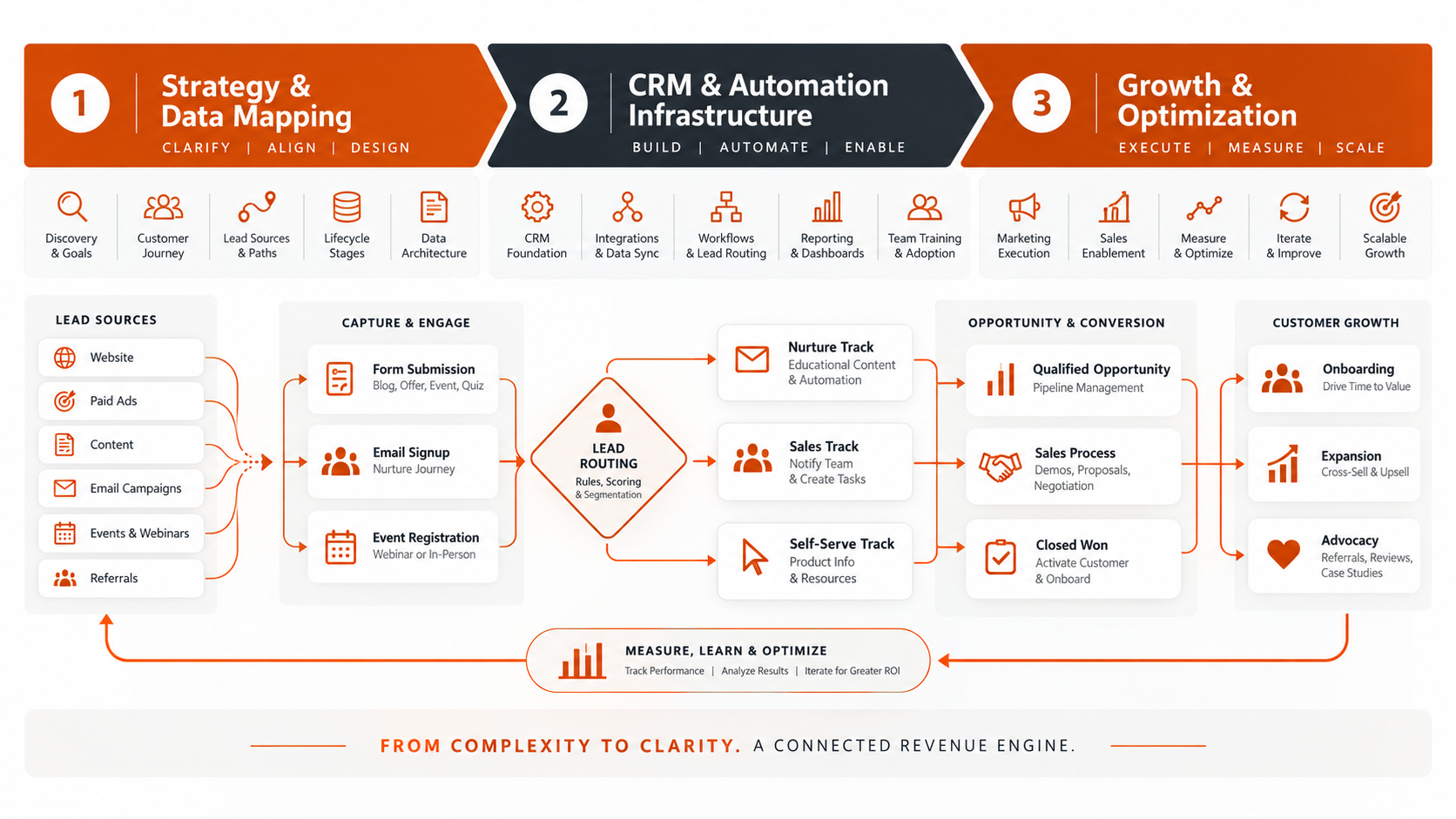
Every engagement begins by mapping how leads, customers, data, and activities move through your organization.
We'll look at the customer journey from first touch through closed revenue—and beyond—to identify gaps, unnecessary manual work, disconnected systems, reporting limitations, and opportunities for automation.
The outcome is a clear blueprint for what HubSpot needs to do and how the pieces should work together.
Understand goals, challenges and current processes.
Visualize customer journeys, data flows and handoffs.
Create the architecture and implementation plan.
Properties, objects, pipelines and data structure.
Workflows, lead routing and lifecycle management.
Connect HubSpot with the rest of your technology stack.
Dashboards that turn activity into actionable insight.
Once we know how the process should work, I build the HubSpot infrastructure needed to support it.
That can include configuring your CRM, standardizing properties, developing workflows, automating lead routing, connecting other platforms, improving data quality, creating dashboards, establishing lifecycle automation, and removing repetitive manual tasks.
For businesses already using HubSpot, this phase often involves cleaning up and optimizing an existing portal rather than starting from scratch.
Technology alone doesn't create growth. Once the CRM, data, and automation foundation is in place, we use it to improve how your teams market, sell, report, and make decisions.
That may mean building nurture campaigns, improving segmentation, enabling your sales team, creating executive dashboards, analyzing attribution, improving conversion points, or identifying new automation opportunities.
And the process doesn't stop at launch. As real customer and revenue data begins flowing through HubSpot, we can see what's working, identify friction, and continuously improve the system.
Put campaigns, workflows and processes into action.
Connect activities to pipeline, revenue and outcomes.
Use real performance data to continuously improve.
HubSpot works best when strategy, data, marketing, sales, automation, and reporting operate as one connected system.
Automate repetitive processes and give your team more time to focus on customers and growth.
Build a CRM structure your sales, marketing, and leadership teams can actually trust.
Connect marketing and sales activity to pipeline, revenue, and business outcomes.
Create processes and automation that can evolve as your team and business grow.
You're moving to HubSpot and need the CRM, marketing, sales, automation, integrations, and reporting structured correctly from the beginning.
You've been using HubSpot for a while, but the portal has become complicated, reporting isn't trusted, or your team is relying on too many manual processes.
HubSpot works today, but your processes, integrations, automation, or reporting need to mature as the business grows.
Take the free HubSpot Growth Assessment to evaluate your CRM, marketing, sales, automation, reporting, and overall HubSpot strategy—and get a clearer picture of where to focus next.